
Cost of Rapid Prototyping in 2026: Price Guide
Rapid prototyping

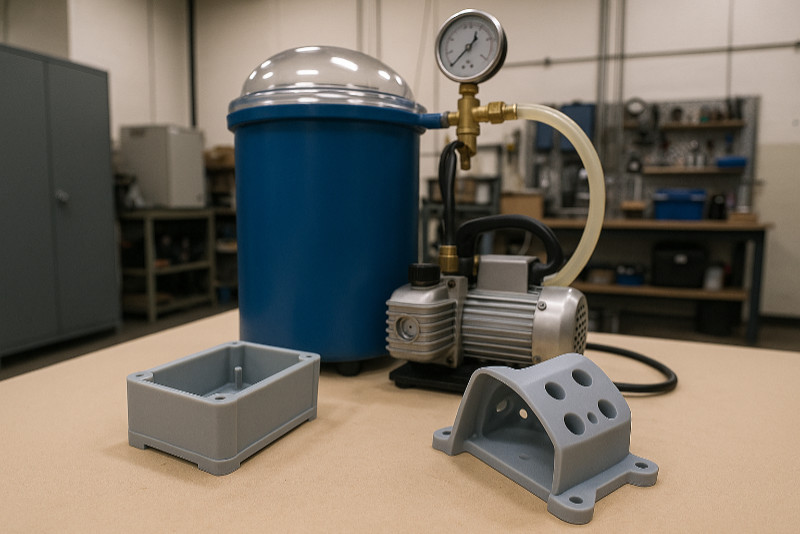
Lately we’ve been doing a LOT of vacuum casting. Often when clients come to us with new projects for prototypes or short-run manufacturing that they want 3D printed, we suggest they actually vacuum cast instead.
Why? Because you can get a better quality result with vacuum casting than you can with 3D printing, and it will be cheaper too!
If you want a quick idea of what your project will cost, use our vacuum casting cost calculator below. Once you’ve got a general idea of cost, you can get in touch for an exact quote – we’ll get back to you in 5-10 minutes! Or for a more in-depth guide into the cost of vacuum casting in 2026, keep reading the article below.
Enter a few details to get a rough idea of mold and part costs for vacuum casting.
Mold cost: $0 – $0
Per part cost: $0 – $0
These figures are general ballpark values only, real quotes can vary with material choice, finish, color, supplier, shipping and taxes.
You’re probably trying to figure out vacuum casting costs because you need a low‑volume run, a fast prototype, or a custom part that made of production-grade plastic. You might be racing against a deadline. Maybe you have questions about materials, tolerances, lead time, or are just wondering “what’s this going to cost me?”
At J-CAD Inc. we make it simple: you bring your CAD file (or we help you create it if you prefer), then we guide you through resin choice, mold design, and setup, and then we run the vacuum casting process so you get parts that look and feel like the real deal.
We’ve worked with engineers, product designers, R&D teams and manufacturing engineers in automotive, aerospace, medical devices and consumer electronics (plus lots more), so we know your pain points like long lead times, inconsistent quality, obscure costs etc. We’ve built our service to beat those issues. Because we’re very streamlined and run lean we can pass thos ecost savings onto you.
We’re happy to advise you on vacuum casting materials (polymer, silicone, nylon, etc) so you don’t over‑spec and over‑pay for your project. Our vacuum casting machine setup, mold design and post‑processing workflows are efficient so you can hit your cost bracket and tolerance goals. We will give you transparent cost breakdowns including tooling, per‑part, finishing etc. so you can decide fast and with confidence whether we’re the right service provider for you.
If you’re an engineer or prototype lead wondering “what’s this vacuum cast run going to cost”, this article will walk you through the key drivers of cost. We’ll spell out what you should expect, what impacts price, and how you can work with a partner (like us) to minimize cost while hitting your required specifications.
Vacuum casting is often used when you need low-volume plastic parts fast. Compared to injection molding, the cost per mold is much, much lower eg. $200 – $1000USD for a vacuum casting mold, compared to $5000+ for an injectoin mold. Turnaround for vacuum casting is also short. It’s perfect for prototypes or small batch production runs. The process gives solid detail without high tooling expense.
| Method | Best For | Tooling Cost | Lead Time |
|---|---|---|---|
| Vacuum Cast | Low-volume projects | Low – $200 to $1000 | About a week |
| Injection Molding | Large production | High – $5000+ | Up to six weeks |
Urethane casting uses silicone molds and casting polymer to make plastic parts that match production quality. The price depends on mold structure, wall thickness, and polymer type used in the vacuum casting process. Each batch is cost-effective when you only need a few prototypes or functional units.
We can help you balance material selection and part design to hit your per-unit price target while keeping high-quality standards for your prototypes. There’s a lot of flexibility here, so let’s talk!

A few choices shape the final vacuum casting fee. One is your prototype’s wall thickness. Thinner parts need less casting polymer and cure faster. Another is surface finish. A high-gloss look takes longer to smooth and clean.
Also, the type of silicone rubber used affects price, especially for molds that need to handle more than one cavity.
According to J. Lee Nicholson, cost collection in manufacturing works when you “consider all the elements of cost … before you determine the selling price of the manufactured product.”
What this means is that you cannot price a manufactured part properly unless you first understand every cost that goes into making it. How does this apply to a vacuum casting project? Let’s look at an example client project:
A company needs 30 prototype enclosures for a small electronics product. To make the enclosures they need to account for:
1. Master pattern
CNC or SLA pattern: $250 USD
2. Silicone mold
They need two cavities, each able to make about 15 parts.
Silicone tooling cost: $600 USD
3. Materials
Polyurethane resin cost: $8 USD per part
Colorant and additives: $1 USD per part
4. Labor
Casting, degassing, trimming, and demolding: $12 USD per part
5. Post processing
Light sanding and primer: $4 USD per part
6. Scrap
Typical loss: 2 parts ruined during early runs. Scrap cost: 2 parts x (resin 8 + colorant 1 + labor 12) = $42 USD
7. Overhead
Shop time, electricity, equipment use, project handling
Allocate $100 USD for this small job.
Therefore the total cost of the production run will equal:
Master pattern: $250
Silicone mold: $600
Resin: 30 x 8 = $240
Colorant: 30 x 1 = $30
Labor: 30 x 12 = $360
Post processing: 30 x 4 = $120
Scrap: $42
Overhead: $100
Total project cost: $1,742 USD
Cost per finished part
$1,742 USD divided by 30 = $58.06 USD per enclosure
Any projected profit can be added on top of the per enclosure price if the product is being mass produced.
Vacuum casting materials include options like nylon, AB, and polyurethane. Each has different mechanical properties, cost, and surface quality. Choosing the right polymer affects everything from part durability to mold life.
This matters most when you’re testing high-quality prototypes or low-volume functional parts. Need toughness? Nylon fits. Need ABS-like feel? AB resin works well.
Depending on material, raw casting costs can range from $18-$20 per unit, to $30-$60 per kilogram.
The vacuum casting process starts with an SLA 3D printing master model. A silicone forms around it, then polymer gets poured inside while a vacuum pump removes air bubbles. After cure time, parts come out ready for post-processing.
Here’s what you’re paying for:
| Step | What It Covers |
|---|---|
| SLA 3D printing – $150-$400 | Builds the master model |
| Silicone mold creation – $200-$1,000 | One-time setup for each batch |
| Resin casting – $8-$40 per part | Material and pour process |
| Vacuum chamber run – $5-$15 per part | Removes air from each cavity |
| Demolding and cleanup – $10-$25 per part | Manual labor, minor polishing |
From a best‑practice summary in manufacturing cost management: “Manufacturing costs consist of direct materials costs, direct labour costs, and manufacturing overheads.”
Design vacuum choices can change how much your prototype costs. Small changes like avoiding an undercut or tweaking wall thickness can drop your mold price fast. We can offer fast custom tweaks on these so you don’t waste money.
Need a one-off or a small series? Vacuum casting 3D printing beats CNC machining and 3D printing in setup time and soft tooling. And it keeps the per mold cost low.
If you’re making high-quality prototypes and low-volume production, vacuum casting beats CNC machining for unit cost. CNC works best when tolerances are tight or you’re cutting metal, but casting gets you plastic parts faster and cheaper.
Also, 3D printing CNC machining hybrids can help when you need quick iterations. Start with SLA, cast with PU, then machine features if needed.
We have a huge range of experience across manufacturing types, so we can compare your options with you, based on:
We’ll make sure we focus on high quality while still getting you a great cost.
Because as Henry Ford once said,
“Quality means doing it right when no one is looking.”
Before hiring a vacuum casting service, check what’s included. Some manufacturers leave out polishing, cure time, or rework costs. Others don’t tell you how many cycles your silicone can handle per batch.
We try to keep everything clear. We show what affects your vacuum casting charges and help you avoid surprises later.
Before starting a project, make sure to ask your vendor:
You’re looking at mold costs often between $200 and $1,000 for silicone tooling, plus a per‑unit price of about $10‑$100 depending on part size, complexity, resin choice and finishes.
Thicker walls use more resin and increase labor trimming time. More cavities mean higher tooling cost but lower per‑unit cost when volume rises. If you keep your design to one cavity with a moderate wall thickness you’re project is going to be more cost‑effective for small batch prototypes.
Yes, but only for short runs and prototypes. For large scale production you’d still use regular injection molding. Vacuum casting services let you explore production‑grade resin choices without the upfront cost of steel tooling and mold making.
Your resin (polyurethane, AB‑like, nylon‑like etc.) is the main driver of both price and performance. Tougher materials (eg. nylon‑like) cost more. Simpler resins cost less. Pick what you truly need, so you avoid overpaying just for bench specs you won’t use.
Some not-so-well-known costs to watch out for include: Post‑processing (eg. polishing, painting), mold life span (eg. how many parts you can cast from one mold), design changes or complexity (eg. undercuts or complex features), and other things like lead time all impact cost. Make sure your quote covers those when you’re getting your project quoted or you can face unexpected surprises.

Jason Vander Griendt is a Mechanical Engineering Technician with years of experience working at major companies such as SNC Lavalin Inc, Hatch Ltd. Siemens and Gerdau Ameristeel. He is the CEO of JCAD – Inc., a company he started in 2006 after seeing a gap in the market for businesses who could assist clients through the entire product design and manufacturing process.
Jason has been featured in Forbes, has had his businesses analyzed and discussed in multiple start-up books, was a previous winner of the Notable8 Digital Innovator of the year award, and is a regular guest on business panels and podcasts. Email Jason at , or follow him on LinkedIn.

